This post is sponsored
For a project so small, socks have an unusually strong hold on knitters. People who begin with scarves or blankets often reach a point where they want something more engaging, more technical, and frankly more satisfying to finish. That is usually where socks enter the picture.
At first glance, sock knitting can seem oddly specific. Why spend hours making something that mostly lives inside shoes? Yet that question misses the real appeal. Socks sit at the intersection of usefulness, skill-building, and pleasure. They are practical enough to justify the effort, but intricate enough to keep your attention. Few knitting projects manage that balance quite so well.
A Small Project With a Big Sense of Progress
One reason socks feel so rewarding is simple: they move quickly. Compared with sweaters, throws, or even a long scarf, a sock project gives you visible progress in short bursts. A cuff appears in an evening. A heel takes shape in a weekend. Before long, you are holding something unmistakably wearable.
That momentum matters. Knitting is often as much about process as product, but motivation still depends on seeing a project evolve. Socks deliver frequent milestones: cuff, leg, heel flap, gusset, foot, toe. Each stage feels distinct, so the work rarely drags. Even the second sock, which could feel repetitive, often becomes more enjoyable because the rhythm is familiar and your hands know what to do.
Portable by Nature
Socks also fit real life. A sweater can sprawl across your lap; a blanket demands space and commitment. Socks, by contrast, live happily in a project bag. They are easy to carry on a commute, during travel, in waiting rooms, or while sitting through a long call. For knitters who struggle to carve out large blocks of crafting time, that portability makes a difference. Ten quiet minutes here and there can still move the project forward.
The Commitment Feels Manageable
There is another psychological advantage: socks do not ask for a huge leap of faith. You are not buying yarn for a garment that may or may not fit months later. You are not facing hundreds of rows of repetitive stitching before anything interesting happens. The scale is modest, and that lowers the barrier to trying new ideas.
Socks Teach Technique Without Feeling Overwhelming
If you want to become a more confident knitter, socks are one of the best classrooms available. They ask you to practise shaping, counting, tension control, and construction in a format that stays contained. You are learning real garment-making principles, just on a smaller stage.
A single pair may include knitting in the round, ribbing, increases, decreases, short rows, picked-up stitches, and grafting. That might sound like a lot, but sock knitting rarely throws those techniques at you all at once. They unfold step by step, and each one serves a clear purpose. You are not memorising abstract methods; you are using them to solve a concrete problem of fit and structure.
For knitters who are ready to move beyond basics, that is part of the appeal. Socks stretch your ability without becoming unwieldy. If you are curious but unsure where to begin, a clear guide can make the learning curve feel much gentler. Resources that help you learn to make handmade socks can demystify everything from heel construction to sizing, which is often all it takes to turn hesitation into enthusiasm.
Mistakes Stay Teachable
Another underrated benefit is that mistakes in socks are usually manageable. If your tension shifts, you notice it quickly. If your heel turn looks odd, you can rip back without sacrificing weeks of work. The project is complex enough to teach you something, but compact enough that errors feel instructive rather than discouraging.
That balance is rare. On larger projects, a mistake can hide for inches before revealing itself. On socks, feedback is immediate. You learn faster because the project answers back.
They Are Deeply Practical, Which Changes How They Feel to Make
Handmade socks are not just decorative. They get used. That practicality gives the knitting a different emotional weight. A finished pair does not sit on a shelf waiting for the right occasion; it enters your daily routine.
There is something satisfying about making an object that earns its place. A good sock provides warmth, cushioning, and comfort in a way that is easy to appreciate. Many knitters also find that hand-knit socks outperform mass-produced ones in fit, especially when they tailor the foot length, leg height, or stretch to suit the wearer.
Fit Becomes Personal
That custom element is a major part of the reward. Feet are oddly individual. Store-bought socks make compromises because they have to fit many people at once. A knitted sock can account for a narrow heel, a high instep, wider toes, or a preferred cuff tension. The more pairs you make, the more precisely you understand what works.
And once you discover your ideal formula, sock knitting becomes a reliable pleasure rather than a gamble.
There Is Room for Creativity Without Chaos
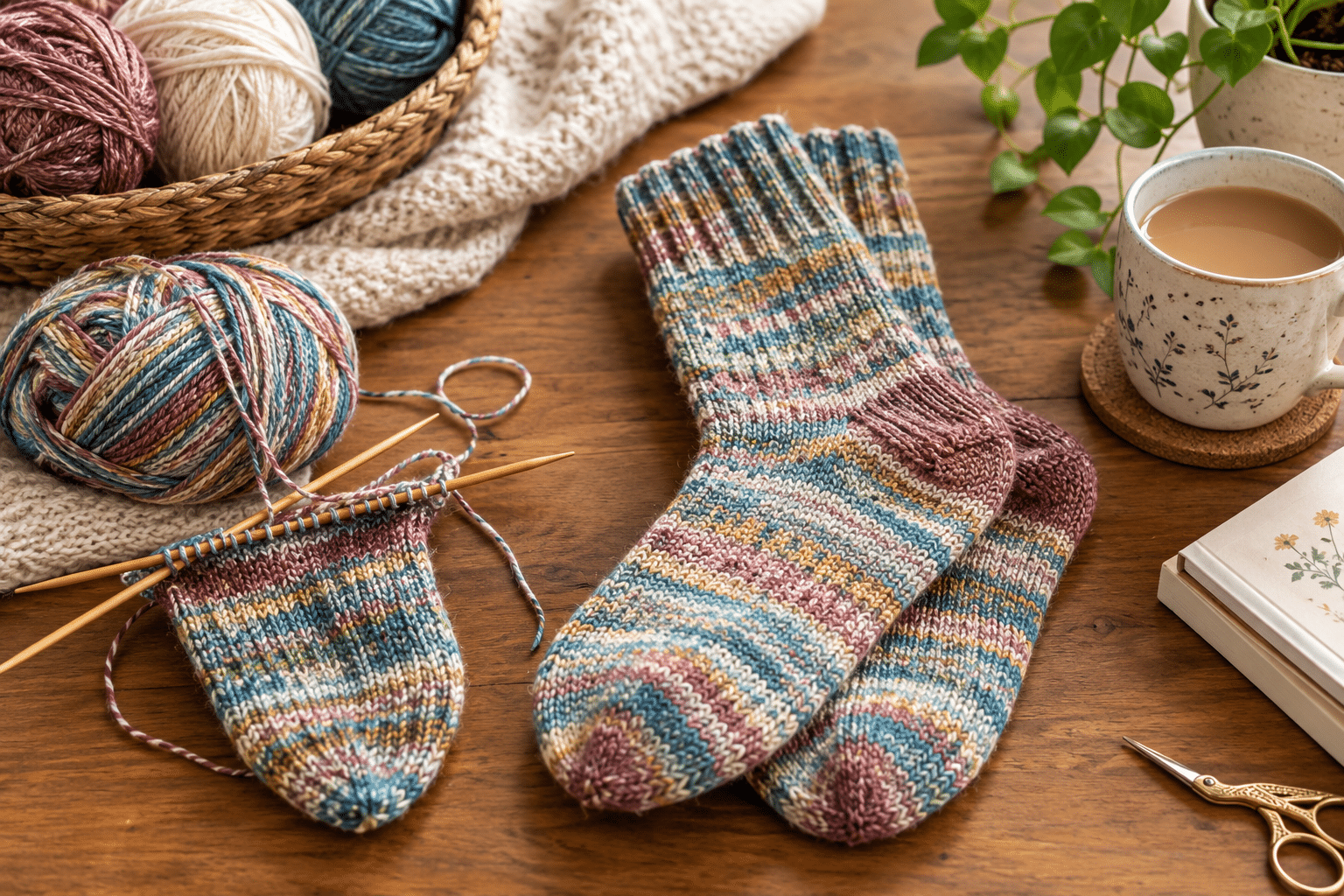
Socks offer a rare kind of creative freedom. Because they are small, you can experiment with bold colour, textured stitches, stripes, lace panels, or self-patterning yarns without feeling locked into an enormous project. A wild skein that might overwhelm a sweater can become a delightful pair of socks.
Structure Supports Play
The best part is that the basic architecture stays consistent. You can be adventurous with surface design while relying on a familiar construction underneath. That combination of novelty and stability is part of what keeps experienced knitters coming back. The canvas changes, but the framework remains dependable.
Socks also make excellent gifts for this reason. They feel thoughtful and personal, but they are not as risky to size as many garments. A hand-knit pair carries visible care without demanding the same level of fitting precision as a jumper or cardigan.
The Reward Is Bigger Than the Finished Pair
In the end, socks are rewarding because they offer more than one kind of payoff. You get the pleasure of progress, the challenge of skill-building, the usefulness of an everyday item, and the quiet pride of making something that fits beautifully. They ask enough of you to stay interesting, but not so much that they become exhausting.
That is a powerful combination. A sock project can sharpen your technique, restore your knitting confidence, and give you something genuinely enjoyable to wear. Not many projects manage to be practical, portable, creative, and educational all at once.
Perhaps that is why sock knitters so often become devoted sock knitters. Once you have turned a strand of yarn into something this functional and finely made, it is hard not to want to do it again.
Loved this craft? More printable fun in the shop:
Browse the full shop•Complete Alphabet Bundle — $24.97•Uppercase Alphabet Crafts — $14.97